


Last Updated: November 12, 2026
Quick Summary
When evaluating gated RV parks, verify that the gate is backed by real procedures: controlled entry with individual codes, security lighting, on-site management, and a written visitor policy. Then confirm site fit, hookups, and lease terms in writing before you book.
- Ask what happens at the gate at 11 p.m. on a Saturday, not just whether a gate exists.
- A shared entry code that never changes relies on the honor system, not real access control.
- Confirm pad length, width, and slide-out clearance against your rig’s actual footprint.
- Test electrical, water, and sewer hookups within the first hour after you plug in.
- Get rates, utility billing, deposit, and cancellation terms in writing before you pay.
Table of Contents
- Why Gated Access Matters More Than You Think
- RV Park Security Features That Actually Protect Your Rig
- The RV Park Site Checklist: Hookups, Pads, and Layout
- Long-Term RV Park Amenities That Hold Up Over Time
- Questions to Ask Before Booking an RV Park
- Conroe Location, Weather Readiness, and What Surrounds the Park
- Rates, Lease Terms, and Matching the Park to Your Stay
- Reserve Your Spot at FourOaks Village
- Frequently Asked Questions
Why Gated Access Matters More Than You Think
Gated RV parks offer the most reliable signal that a park takes security seriously, because a controlled entry point forces every visitor, contractor, and delivery driver through a checkpoint.
Most guides treat the gate as the whole security story. It is not. A gate with no on-site management, no lighting, and no visitor log is theater.
When you evaluate gated RV parks, ask a second question after “is there a gate?” Ask what happens at that gate at 11 p.m. on a Saturday.
RV Park Security Features That Actually Protect Your Rig
The security features that genuinely protect an RV are a fenced perimeter, controlled entry with a keypad or code system, security lighting across the site, on-site management presence, and a documented visitor access policy.
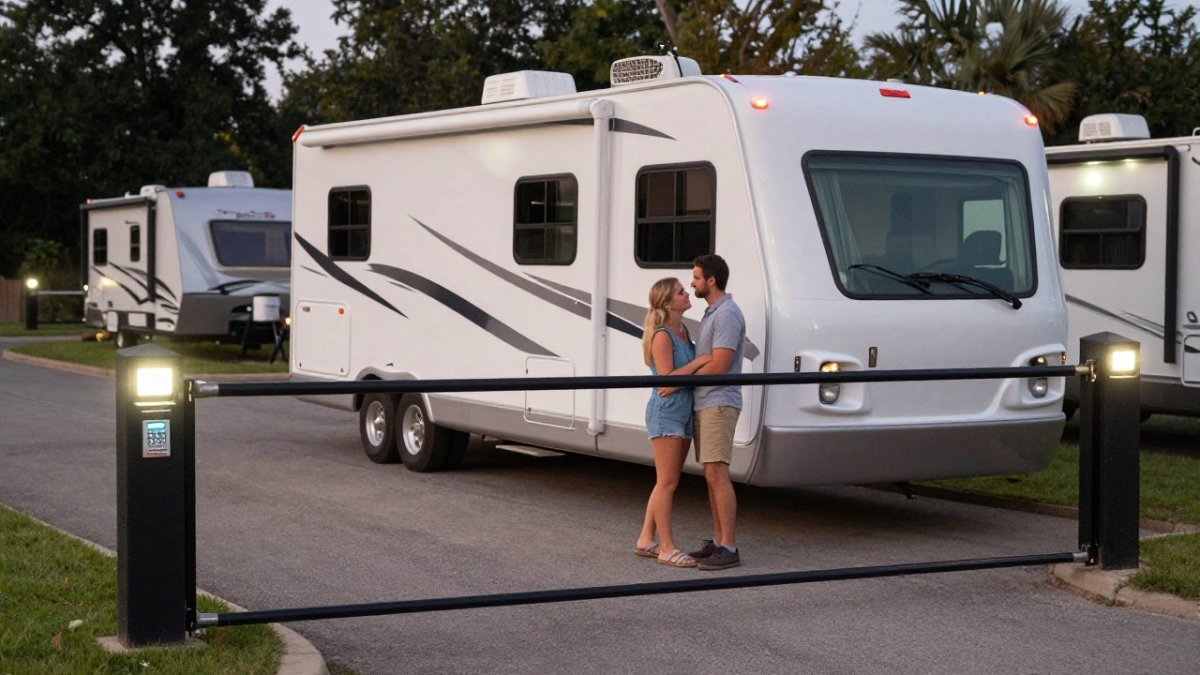
A common mistake is assuming “gated” means “monitored.” A gate that opens with a shared code keeps out casual traffic but does not tell you who is inside the park.
How to Verify Security Claims Before You Arrive
Treat every security claim as a question with a testable answer. The goal is to learn how the park actually operates at 11 p.m. on a Saturday.
Gate operation and access control
- Ask how the entry code is issued and to whom. A park that issues one shared code to every guest and never changes it relies on the honor system. A park that issues individual codes, logs them, and deactivates them at checkout has an auditable record of who came and went.
- Ask whether the gate is open during office hours and closed after hours, or closed 24/7. An open daytime gate with a staffed office is normal; an open gate with no office presence is a different risk profile.
- Ask what happens at the gate when the office is closed. Is there a call box, a keypad, a resident manager who answers, or nothing? “Nothing” is worth knowing.
Lighting and cameras
- Ask where the security lighting is and whether it covers interior roads, the bathhouse and laundry areas, and the dump station, not just the entrance. Walk the park after dark if you can, or ask for a site near a lit road if you will arrive after sunset.
- Ask where cameras are mounted and, more importantly, who reviews the footage and how long it is retained. A camera that records to a box nobody checks is a deterrent at best; one monitored by an on-site manager or contracted service is a different level of protection.
- Ask whether the park has had any security incidents in the past year and how they were handled. A well-run park will answer without defensiveness; a park that refuses is telling you something.
On-site presence and patrols
- Ask who is on site overnight. Options range from a resident manager living in the park to a contracted security patrol to no overnight presence at all. None is automatically wrong, but you should know which one you are buying.
- Ask how after-hours problems are reported and what the response time is. A posted after-hours number and a resident manager is very different from a voicemail box.
- Ask whether the park has a written incident procedure for theft, disturbance, or a safety issue. The existence of a procedure matters more than the specifics.
Reviews and reputation
- Read recent guest reviews specifically for mentions of security, lighting, noise after dark, and how management responded to problems. Long-term residents notice security gaps that weekend visitors miss, so weight reviews from people who stayed a month or more.
- Look for patterns rather than single complaints. One bad review about a noisy neighbor is noise; three reviews about the gate being propped open are a pattern.
If a park hesitates on any of these questions, treat the security claim as unverified. You can also check guest testimonials and reviews from people who have stayed through a full season.
Watch out: a gate that looks impressive in photos can be propped open during busy check-in hours, and a keypad that accepts a shared code is only as secure as the last guest who wrote the code on a napkin.
The RV Park Site Checklist: Hookups, Pads, and Layout
A site is only as good as its pad, its hookups, and the space around it. But “good” is relative to your rig: a 40-foot Class A with four slide-outs and a tow vehicle has very different requirements than a 24-foot travel trailer, and a park that markets “big-rig friendly” sites may have only a handful that actually fit. Run this checklist against your own measurements rather than the park’s marketing language.
Site Fit: Dimensions, Turning Radius, and Surface
Start with the numbers. Ask for the site’s pad length and width, the distance between the pad and the nearest obstacle (utility pedestal, tree, neighbor’s slide-out), and the width of the interior roads leading to it. Compare those to your rig’s actual footprint, including the tow vehicle or toad.
- Pad length and width. A pad that fits your RV may not fit your RV plus your tow vehicle or toad. Ask whether a second vehicle can park on the pad or must go in a separate lot.
- Slide-out clearance. Ask how much clearance exists between the pad edge and the neighbor’s pad. Two rigs with opposing slide-outs can crowd a site that looks spacious on a map.
- Turning radius and interior roads. Ask whether the roads are paved and how wide they are, and whether the turn into your site is a wide sweep or a tight angle. A pull-through site solves backing but not necessarily turning if the interior road is narrow.
Hookups: What to Confirm Before You Book
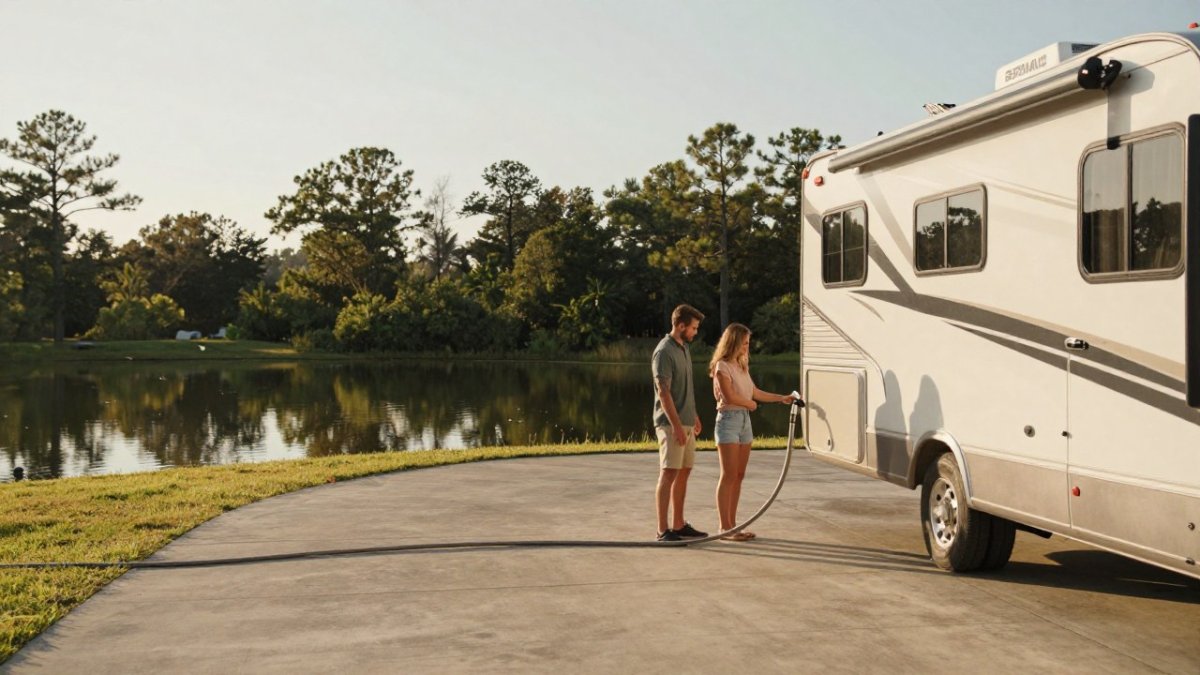
Hookups are where a site either works or does not. Confirm each of these with the park before you arrive, and test them within the first hour after you plug in.
- Electrical hookup matches your needs: 30-amp service or 50-amp service, with 20-amp available if you need it
- Water hookup delivers steady pressure with no visible leaks at the pedestal
- Sewer connection sits at the right height and distance for your hose run
That last item deserves emphasis. Site layout varies enormously within a single park, so ask for a site number and check coverage there specifically. A park with strong signal at the office can have a dead zone at the back of the property.
Electrical, Water, and Sewer: What to Test on Arrival
Test the hookups yourself within the first hour. Plug in and check your surge protector’s readout for correct voltage. Run a tap and watch the pressure.
Ask whether utilities are included in the rate or metered separately, and if metered, how the meter is read and billed.
Watch out: skipping the arrival test is how small problems become expensive ones.
Long-Term RV Park Amenities That Hold Up Over Time
The amenities that matter for a long-term stay are the ones you use weekly, not the ones that photograph well. Full hookups, a swimming pool, and a community pavilion separate a park you tolerate from one you settle into.
Ask how each amenity is maintained. If you want to see the specific facilities a park lists, review the amenities offered at Four Oaks Village RV Park, including the 20, 30, and 50 amp stations, pool, pavilion, and fishing pond.
Pet owners should confirm exactly what “pet-friendly” means at any park they consider, including whether dedicated walking areas are provided.
Questions to Ask Before Booking an RV Park
The right questions reveal how a park operates day to day. Ask about overnight management, utility reliability, lease terms, visitor policy, and what happens when something breaks.
Specific questions worth asking:
- What are the monthly rates, and what do they include?
- Are utility costs bundled or metered separately?
- Is there a minimum or maximum length of stay?
- How is visitor access handled for guests?
- What is the process if my hookup fails on a Sunday?
- Are there noise restrictions, and how are they enforced?
- Is there on-site storage for boats or trailers?
Write the answers down. If a park will not put terms in writing, that is your answer. For anything still unclear, contact the FourOaks Village team directly rather than relying on a third-party listing.
Conroe Location, Weather Readiness, and What Surrounds the Park
Location and drainage decide whether a park works for you in practice.
Summer storms and heavy rain can affect drainage, so it is worth checking how a site handles water. Walk the site after rain if you can, or ask which sites sit highest.
Convenience matters too. Proximity to major interstates makes weekend trips and day trips easier, and proximity to schools, restaurants, and hospitals matters if you are staying for a work assignment rather than a vacation.
Rates, Lease Terms, and Matching the Park to Your Stay
Rates and lease terms should match your length of stay, and the best way to compare is to ask each park for a written breakdown. Pricing depends on factors such as site type, season, and length of stay, so request a written quote from FourOaks Village for current prices.
Match the park to your situation:
| Traveler Type | Priorities | What to Confirm |
|---|---|---|
| Weekend traveler | Location, pull-through site, pool | Daily rate, check-in time, visitor policy |
| Full-time RVer | Lease terms, utilities, community | Monthly rate, utility billing, length-of-stay limits |
| Family | Space, safety, nearby schools | Site layout, noise rules, amenities for kids |
| Contractor on assignment | Stability, convenience, internet | Monthly terms, cell coverage, distance to work |
| Seasonal resident | Comfort, amenities, weather readiness | Seasonal rates, drainage, on-site management |
Ask whether utilities are included or metered, what the deposit and cancellation terms are, and whether the rate changes with the season. Get it in writing before you pay.
Reserve Your Spot at FourOaks Village
Choosing a gated RV park comes down to verified details: who watches the gate, whether the pad is level, how the hookups perform, and what the lease actually says. If you are ready to settle in, reserve your spot at FourOaks Village.
The gap between a park that looks secure and one that actually is comes down to a handful of questions most travelers never ask. Ask them, get the answers in writing, and your stay starts on solid ground.
Frequently Asked Questions
What security features should gated RV parks have?
Look for a controlled entry gate with a keypad or code system, a fenced perimeter, and security lighting across the site roads and pads. On-site management during office hours and cameras at the entrance add another layer. Ask how often footage is reviewed and who responds to after-hours issues. A gate alone means little if nobody monitors it, so confirm the gate closes automatically and that visitor access is logged rather than left open overnight.
What should I ask before choosing an RV park for a long-term stay?
Ask about lease terms and whether monthly rates include utilities or bill them separately. Confirm the amp service at your specific site (30-amp versus 50-amp), water pressure consistency, and how sewer connections are set up. Ask about length-of-stay limits, guest policies, and noise rules. Also request the site dimensions and pad material so your rig fits before you pay a deposit. Get answers in writing where possible.
Does a gated entrance make an RV park safer?
A gate reduces casual drive-through traffic and makes it harder for someone to enter unnoticed, but it is one layer, not a guarantee. Pair it with a fenced perimeter, lighting, on-site management, and a visitor check-in process. When you tour a park, watch whether the gate actually closes behind each vehicle and whether codes are changed between guests. Those habits tell you more about real security than the gate hardware itself.
What amenities matter most for long-term RV living?
Reliable full hookups top the list, followed by laundry facilities, showers, and dependable Wi-Fi or cell coverage for work. A dog-walking area or pet-friendly policy matters if you travel with pets, and a pool or community pavilion adds comfort during extended stays. Ask how often amenities are maintained and whether they stay open year-round. For long-term residents, the day-to-day comfort of a park often matters more than extras like a fishing pond.
How can I check whether an RV park is well maintained?
Walk the site before booking and look at the concrete pads for cracks or uneven surfaces, check that roads are paved and drained, and inspect the bathhouse and laundry room for cleanliness. Ask current guests about water pressure and internet reliability. Read recent reviews for patterns, not single complaints. A park that keeps its pads level and its amenities working is usually managed well, and that consistency carries into your stay.
What is the 10-year rule for RV parks?
Some RV parks restrict rigs older than 10 years, usually to keep the property looking uniform. Policies vary widely, and many parks review older RVs case by case if they are well maintained. Before booking a long-term stay, ask directly whether an age restriction applies and whether it is enforced at check-in. If your rig is older, send photos in advance and get approval in writing so there are no surprises on arrival.

